
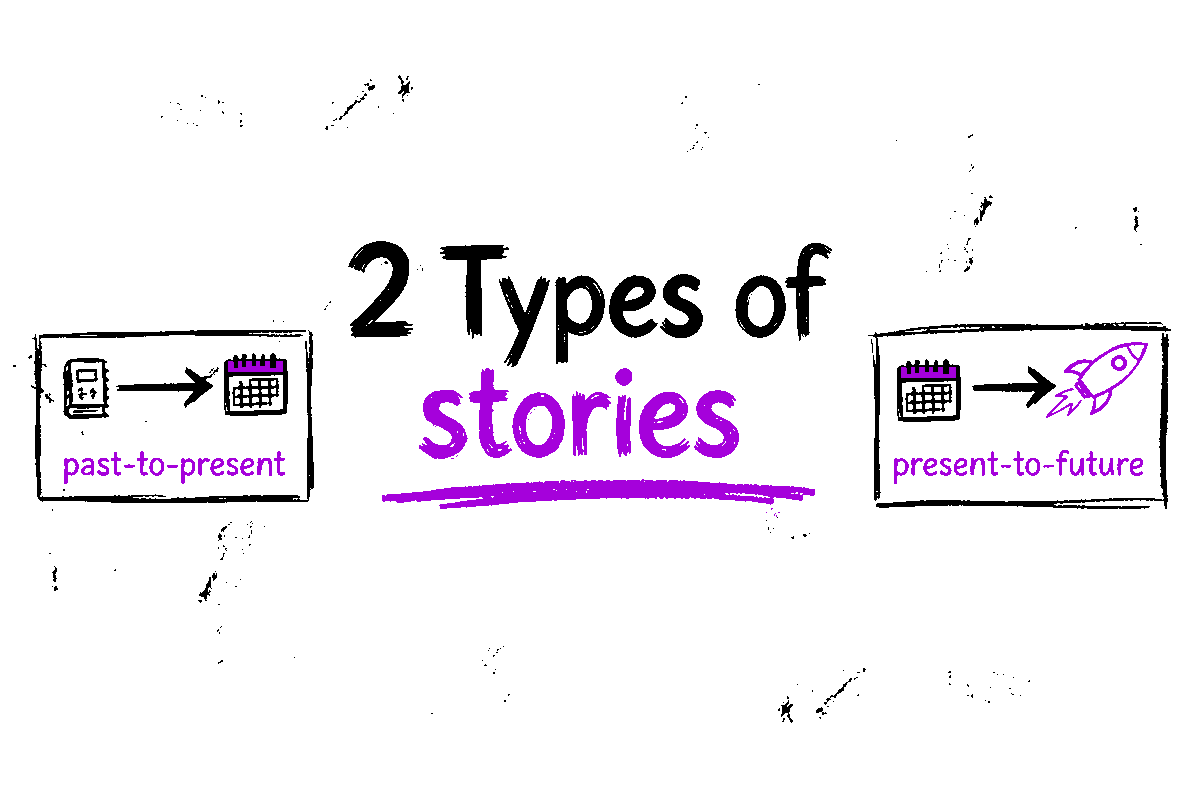
2 Types of stories in business storytelling

You know how important storytelling is.
You decided to learn it and use stories in your business.
So you watch videos, read books, ask AI about it.
You hear people talk about telling stories like:
- saying something important to the audience, staying strong even though you were nervous
- getting out of difficult situation victorious
- encountering someone important
Stories about past events.
Stories from someone’s life, personal or professional.
Stories where the meaning is some profound life lesson.
You hear other people talk about a different type of story.
A story that is more about the present and the future, not the past.
A story that explains your business.
Reasons why you do what you do.
Reasons why a customer should care.
Reasons why you are different from competitors.
Ways in which you’re changing the person’s live.
Ways in which you’re changing the world.
Stories where the goal is to make your company stick in a person’s mind.
Make it memorable.
Make it own the problem.
Own the solution.
Own the category.
Own the niche.
Own mindshare.
But you don’t hear people making a distinction between them.
You don’t hear about these stories being different types.
Storytelling content doesn’t explain the key differences.
Now, sure, both types follow many similar rules and principles.
Both work well when the audience thinks “this applies to me”, “he understands me”.
Both are built around problem, change and resolution.
Both are important to your business.
And both are important to your personal success.
But on a practical level it’s important to know what you currently need the most.
Do you want to give a keynote speech to show a lesson in leadership based on your achievements?
Or do you want to make more people believe in your future vision for the company and category?
Let’s cover the differences between the two.
2 worlds of stories
2 types I’m talking about are:
- Past -> Present (history, what already happened)
- Present -> Future (perspective, missing gap, potential, what can happen)
All specific stories (and specific places/assets that use storytelling) follow one of these 2 types.
1. Examples of business stories & texts that show past-to-present transformations:
- Origin story, founder story, “About us” page - why you do what you do
- Pivot story - when you hit the wall, failed, but changed the direction and succeeded
- Culture code, explainers to employees on why things must be done your way
- Case studies, customer stories, testimonials
- Behind the scenes content
You usually see this type in social media posts, keynote speeches, articles and press publications.
2. Examples of business stories & texts that show present-to-future potential:
- Website copy, email sequences, sales pages - promises to customers
- Enemy story - showing a villain (e.g frustration, outdated way of thinking) and telling how to defeat it
- Category design story - new way of doing things, that you created
- Vision stories and statements, point-of-view
- Leadership calls to action
- Sales pitches
- Pitch decks
You usually see this type in sales copy and marketing collateral.
1. Most past-to-present stories look like this:
- Hero had a problem (wanted to get something but couldn’t get it)
- He tried some solutions but they didn’t work, until he finally finds something that works (or finds someone who helps him)
- Now he is happy (problem is solved)
Often with some twists and turns along the way, such as a moment of despair right after it felt that everything was working well, and just before the miracle and breakthrough.
They show a closed loop and focus on credibility and trust.
Audience needs to resonate with the hero’s struggle, adventure and resolution, but usually you’re not asking anything of them. You just create the groundwork to turn meaning into action afterwards. Either by clearly adding the ask, or continuing with a present-to-future story.
2. Most present-to-future stories look like this:
- Hero wants something (e.g. solve the problem)
- The guide understands him and can help get it (because he has empathy, authority and experience) by providing a plan and calling to action
- There is a picture of success (hero achieves what he wants) and failure (hero continues to try wrong approaches and loses)
Audience needs to understand the problem and the stakes, trust the guide and his plan, and follow the call-to-action. You’re moving them toward a new reality.
Outcome is not guaranteed yet. Action is required now (or loss occurs).
When talking about big ideas, POV and vision for the future, it mimics the same structure, for example:
- World is in a bad situation right now
- There is an opportunity to make it better
- Here’s how we can achieve a better future
Why you must tell both
Both types of stories share the same ancient story DNA. All good stories have been using pretty similar structures for thousands of years of human existence.
The key difference for your business is WHERE and HOW do you tell them.
Past stories create proof.
Future stories create promise.
One explains why a decision was correct.
The other tries to cause a decision.
Together they create a way to change people (which is Seth Godin’s definition of marketing).
Marketing is the generous act of helping others become who they seek to become. (c) Seth Godin
So when you think about using storytelling for your business - learn to tell both types.
Giving a speech? Start with the past, then lead to the future.
Developing messaging for new visitors? Paint their present and future. Then include the past as hard proof that you can deliver it (clear and specific, not poetic).
Learn to make your words resonate and create change.
This is the main goal of storytelling.
We help you with that. Weekly.