
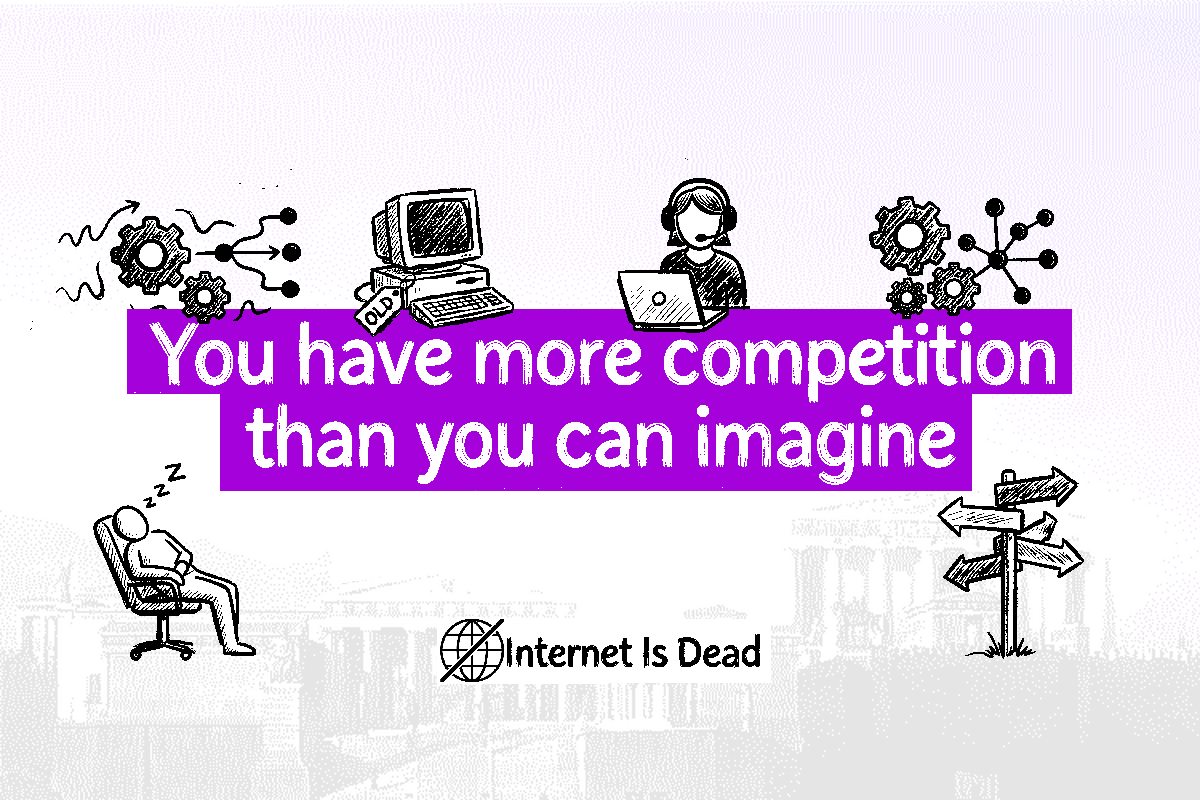
You have more competition than you can imagine

Let’s say you provide business intelligence software and/or service (this applies to everything).
Who are your competitors?
You think you are competing with other business intelligence tools or agencies?
Maybe someone in the nearby categories?
Wrong.
Your competition is much, MUCH bigger.
1. Doing nothing
Yes, that’s really common.
You might think the problem you’re solving is obvious and VERY PAINFUL.
But your potential customers might’ve never even thought about it.
And even if they know about the problem - do they think it’s a big deal?
But if a potential customer both knows about the problem AND thinks it’s important, there are still more enemies to beat - laziness and priorities. The problem might be important, sure, but there are 25 other, more important tasks. That’s what you have to work with. And that’s why you shouldn’t expect to talk to them 1 time and immediately get them as a customer.
2. Staying with existing solution
We are already using X, we don’t need Y.
Almost the same as the option 1. They don’t need to do anything.
But now it can been an even bigger issue for you.
They might not want to switch to you, even if they are NOT happy with their current solution.
Because switching costs can be too high.
And if switching costs are high, they are okay with the current solution, and the problem/opportunity is not even close to their top priorities - there’s almost 0% chance they will switch to you. That’s literally a “competitor” you can’t beat.
Want their customers to come to you? Subscribe for weekly B2B growth guides.
3. Hiring a freelancer or an assistant
If the task can easily be done by cheap labor, why not use it?
Same if the task requires highly professional talent, but it’s still a one-time project. Hiring a freelancer might just be more time-efficient than researching you, watching your demos, having sales conversations, etc.
I was advising one team that had a full-time assistant solving tens of small problems here and there. No specialization. They would NEVER replace him (until some kind of crazy superintelligence automates 100% of the work of course). Funny thing is that if you want to integrate your solution into some of the things he does, he would literally be in the decision making committee.
4. Hiring full-time employee
Not every business likes to hire a lot, but it’s still a good option if the situation requires to do so.
Sure they might need to do some training. But they’ll feel more control and ownership.
Some execs want everything to be done in-house.
5. Using your indirect competitors
Examples:
- When you provide a service, but there are products and software solving the same thing much cheaper, faster, and with more control
- When your competitors frame their offer completely differently from you, but your customer’s specific use case for this competitor matches your offering
There’s always room to achieve similar results in totally different ways. Your customers might be looking for that different way.
6. Vibe coding / Vibe automating
Now that even non-technical people can use AI to solve a lot of problems just by typing in plain English - you have more competition than ever. And it’s not a linear increase.
Not only there’s a lot more players on the market because development became faster. But also companies are replacing the old tools with internally built, custom solutions.
Sure, many of these solutions don’t work, especially when done by non-professionals. But that’s why smart teams hire AI automation experts and empower traditional devs with new tools. And AI models become better and better.
And it’s not just tools being replaced. Employees get fired. Agencies get fired.
There is no point in overpaying for slow legacy stack. If you’re a vendor or service provider and you don’t adapt for this reality - get ready to be replaced.
Practical takeaways
- The more valuable content you provide the easier it becomes to get customers. Educate about the problem/opportunity, add personality - this will be your competitive advantage. At a certain point in scaling it can become an absolute necessity, you can no longer hunt for “3% solution-seekers” only.
- Reduce switching friction as much as you can. Offer migrations and integrations. It can literally be fully custom if the deal is good.
- Position yourself as the right option against all alternatives, not just direct competitors. Or be in a totally different category of one.
- Offer solutions at different levels of the value stack - Do-it-yourself, Done-with-you, Done-for-you, Done-with-AI, etc. You can also partner/integrate with existing solutions outside of your core offer model, to avoid inefficiencies and development time waste.
- Tinker with AI models and new tools, get better at them (across the whole organization). You no longer have the option to ignore what’s happening in this space.
If you want to brainstorm your positioning or category focus - send me an email at leon@wildcardadvisory.com